Engineered CV training data, models and tools.
Unique images produce unique models.
Privileged ground truth produces unique capabilities.
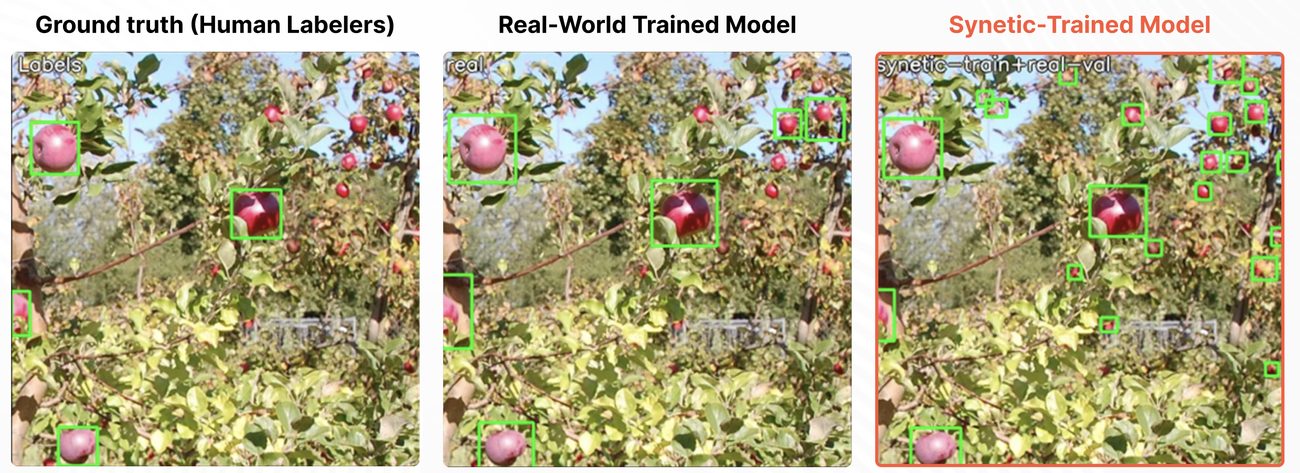
The human labels missed apples. Left is the ground truth a labelling team produced. Right is a model trained only on our data, finding fruit nobody annotated.
Helping CV engineers say yes to differentiating features.
We don’t need your data to start. No collection, no labelled set, nothing captured first.
How do you train a model
when you have no images?
A model learns its features from images. No images, no features, no model — so the answer is always the same. Go and get them first. Wait for the season, send a crew, budget six months for labelling, come back next year.
We don’t need your data to start.
No collection. No labelled set. Nothing captured first. Tell us what the model has to handle, and the images are built for it.
Your model should be
the only one of its kind.
COCO. Open Images. Universe. Hugging Face. The public sets are good, and they are also shared — so models built on them converge. Same classes, same distributions, same blind spots.
Your competitor's model fails on the same rainy Tuesday as yours, because it learned from the same pictures.
Then it’s yours, and it’s your conditions — at the cost of a season, a crew and months of labelling. Plenty of teams do exactly this, and it works.
It also freezes. What you collected is what you have, until you go and do it again.
You choose what it has to handle. The model is built for exactly that.
Not a general model pruned down — a model that was never general. If it will never see snow, it carries nothing for snow. If it only ever looks down from four metres, it carries nothing for anything else.
- Eighty classes you'll never see
- Trained on whatever was photographed
- Sized for the general case
- Hedging its confidence across everything
- Your classes, and only your classes
- Your lighting, weather, angles, distances
- Your edge cases, weighted the way you choose
- Smaller, so it needs less hardware to run
Why should a pump-failure detector reserve capacity for a hippo?
Unless you train from scratch, you warm-start — from ImageNet, from COCO, from whatever the checkpoint was pretrained on. So the model arrives already shaped for a general world, carrying representations for a thousand things that will never enter your frame and hedging its confidence across all of them. Fine-tuning adjusts that. It doesn’t remove it.
Enough fitted data changes what’s possible: a model built for your problem rather than one adapted to it.
Take the dataset and train it yourself, or take the model trained and ready to deploy. Either way it was built for your product.
And it can do things
other models can’t.
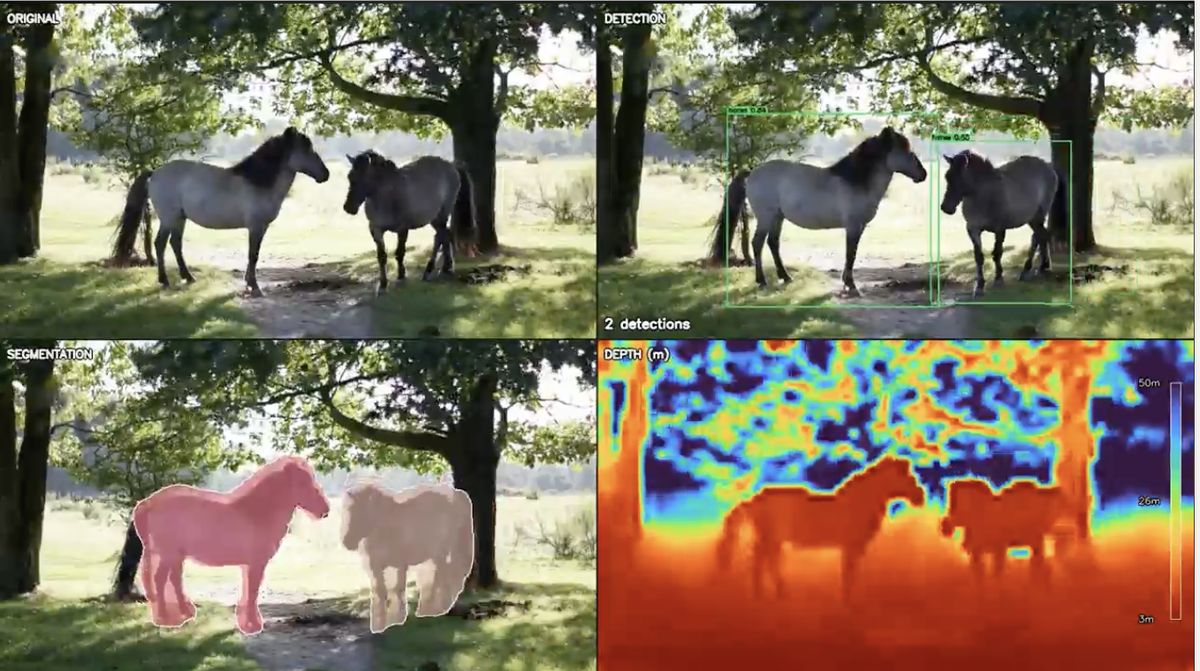
A labeller can draw a box. They cannot draw the hidden half of an occluded object, a distance in metres for every pixel, the direction a surface faces, or a count in a scene too crowded to enumerate.
Those labels aren’t expensive. They’re absent.
The information was never in the photograph, so no annotation budget of any size produces them. Synetic can supply images that carry it.
- Full depth, per pixel
- Annotated hidden objects
- Surface normals
- Identity through total occlusion
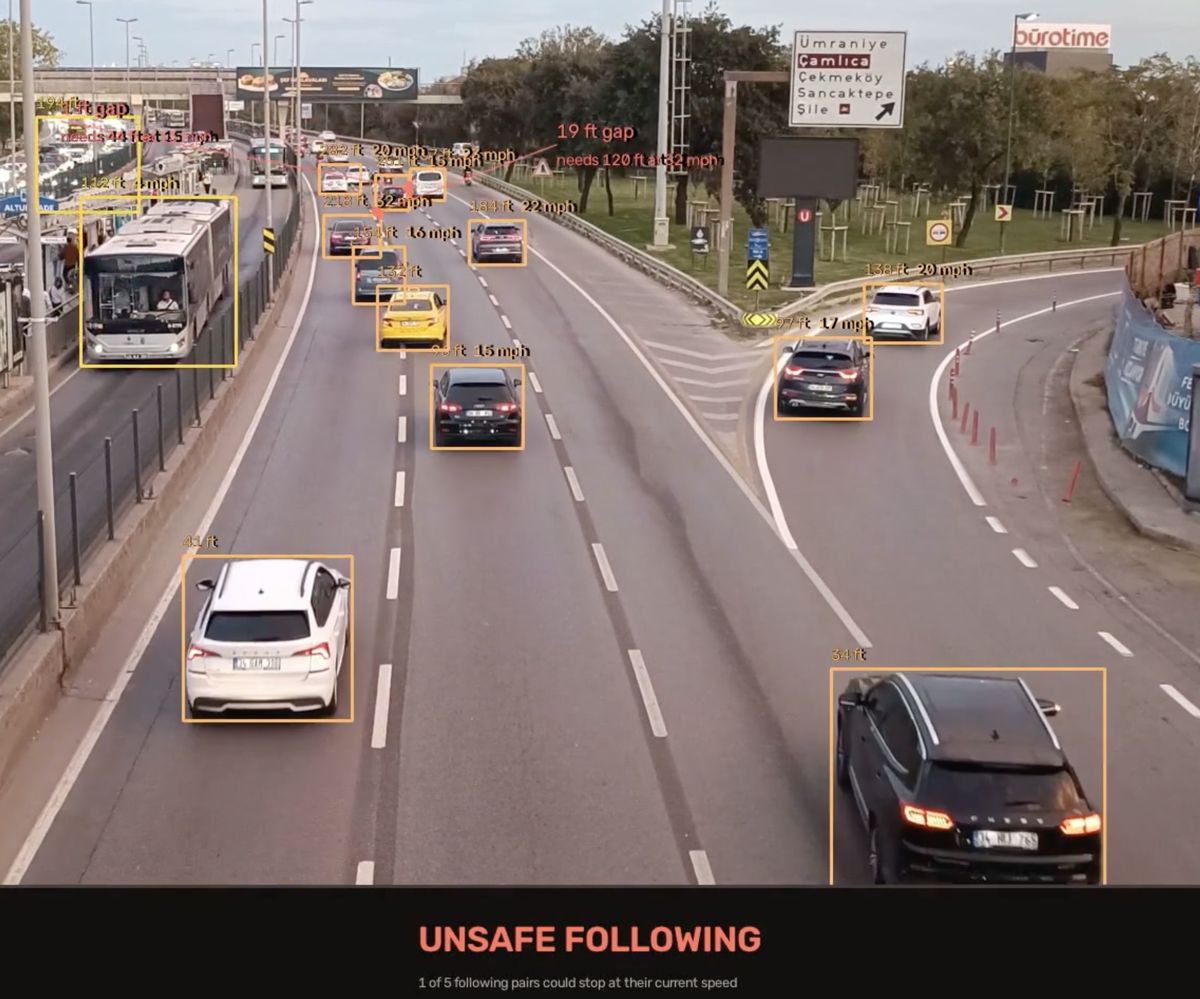
- Density where nothing can be counted
- Metric size, volume and weight
- Rare events nobody can stage
The crop was invisible.
So we counted what was hiding it.
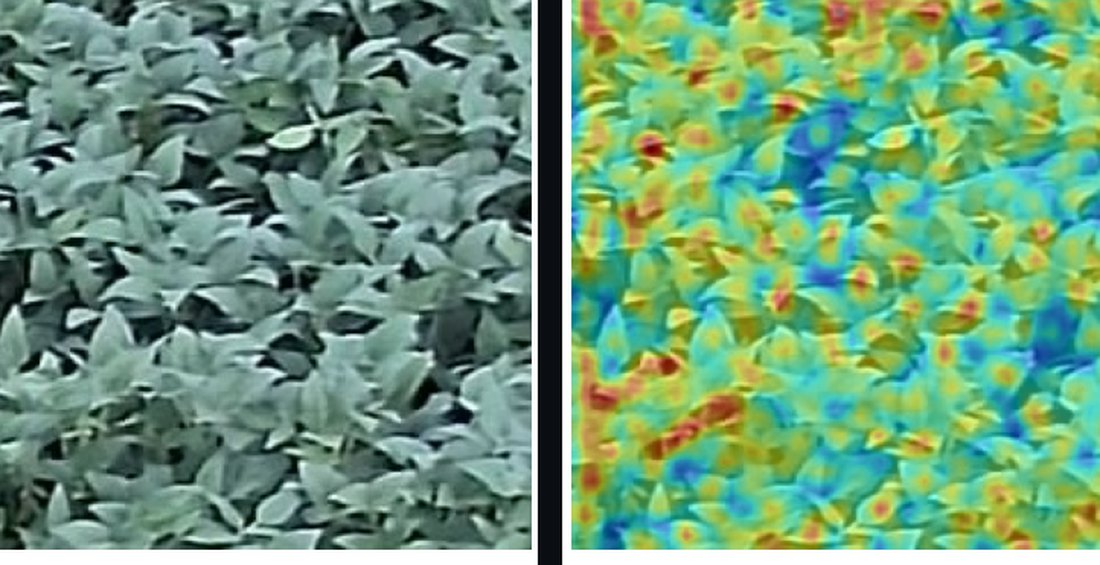
Once the leaves close over they completely cover everything below them. From above there is nothing left to photograph, so growers walk the rows, count what they can see, and extrapolate across the field.
We stopped counting the crop, and counted the canopy instead.
Built and demonstrated on a Bauer pivot at their research site in São Paulo — density read from ordinary RGB, with no specialised sensor.
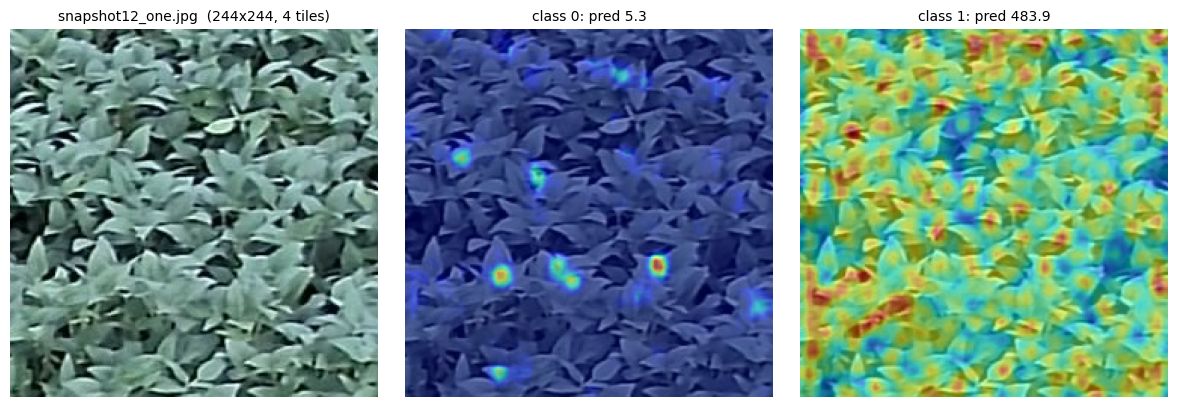
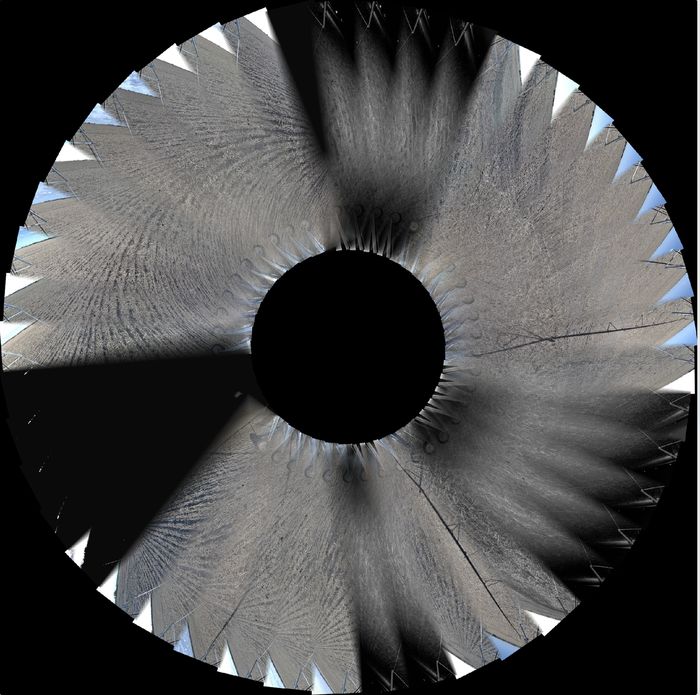
Above: a closed canopy and the model’s density response. Below: a pivot field rebuilt from pivot-mounted cameras as it turns — captured, not rendered.
Seasonal availability is one of the biggest issues in agricultural computer vision.
Selling ahead of a season means last year’s pictures. Or Synetic.
No amount of budget or effort makes a season arrive early. A customer demo was on the calendar and the crop was out of season, so we built the crop instead of collecting it.
When the deadline matters, faster and more dependable than trying to capture it.
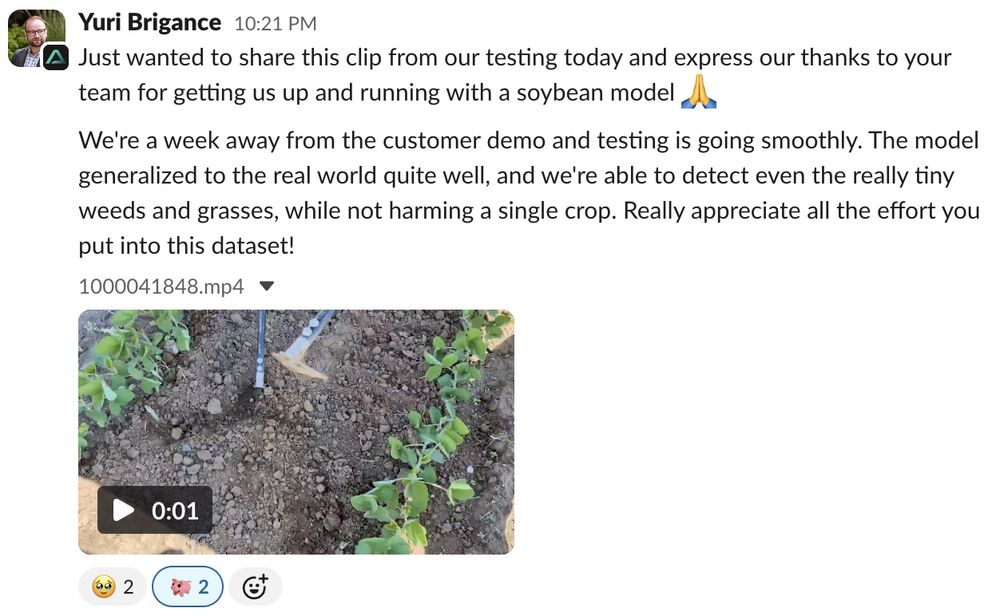
“We trained a model on 99% synthetic data that successfully deployed on our field robots, identifying weeds and triggering treatment without damaging a single crop plant. The data quality was solid enough that we went straight from synthetic training to real-world deployment with minimal friction.”
Yuri Brigance · Director of AI & SW, Aigen
Two to four weeks.
A season.
Or six months.
And you get the conditions the weather gave you.
Two to four
weeks.
And you choose the conditions — including the ones you have never captured and the ones you could never stage.
Then a change is hours, not another year.
Four steps, and you own
everything at the end.
A conversation
Tell us what you'd build. We'll tell you honestly whether it's a problem we solve — and say so if it isn't.
We scope it
Your objects, your cameras, your conditions, your edge cases. And how you'll know it worked.
You have it
Data, or a trained model, or both. Yours outright — no royalties, no restrictions.
We keep going
Iteration and retraining included, until it does what you needed it to do.
Not your data. Not a labelled set. Nothing collected first. We use customer imagery for one thing only — the validation set.
Are you an engineer?
You probably want to try something rather than book a meeting. LYNX is our SDK — bring your own model, run it on your own footage, see what comes back. Free for 30 days, no procurement, no call.
Bring us your hardest one.
Thirty minutes. Tell us what you’d build if the data already existed, and we’ll tell you straight whether we can get you there. No pitch, no junior account rep — a real conversation with someone who has built this.